
Anti-inflammatory Drugs and Chinese Medicine
Anti-inflammatory drugs are commonly prescribed to our patients. And there is probably no drug more widely used among our patient population, when you consider over-the-counter use. This seminar explores this class of drugs including non-steroidal anti-inflammatory drugs (NSAIDs), other analgesics, disease-modifying antirheumatic drugs (DMARDs), migraine drugs, and drugs to treat gout and ulcerative colitis. Join us as we look at the uses, mechanisms of action, cautions, and potential interactions of these agents.
This course will be presented on Sunday, June 29, 2025, from 1-3pm pst via live webinar.
Hosted by
The course will be hosted on Net of Knowledge. You will be given access to the event on Net of Knowledge before the start date. Once your event access has been added you will receive an email letting you know. When you register here, we will pass on your name, email address and country to Net of Knowledge in order to register you for the event.

Course Goals
A participant will be able to:
- Understand how anti-inflammatory drugs and herbs interact
- Identify the most common anti-inflammatory drugs with potential for drug-herb interactions
- Explore how major anti-inflammatory drugs act on the body
- Protect oneself from potential medico-legal issues arising from interactions
This is California Acupuncture Board (CAB) Category 1 live education course. For NCCAOM, this course is a 2 hour safety PDA. This course is approved by the California Acupuncture Board and NCCAOM for 3 hours of continuing education and PDAs. For further information, please contact Dr. Greg Sperber, CAB CEU Provider #1349, NCCAOM PDA Provider #166669, at DrGreg@integrativemedicinecouncil.org or (619) 881-0029.
Refund Policy: A refund request can be made up to seven days before the scheduled webinar and a full refund will be offered. Within a week of the seminar, cancellations will refund half the cost of the webinar.
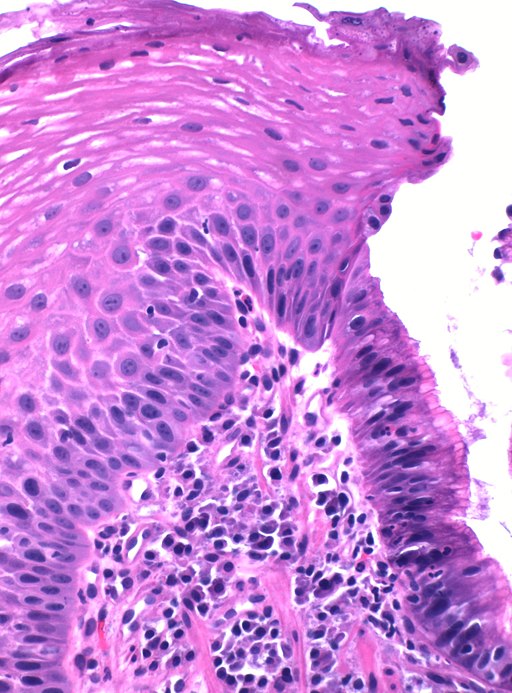
Picture Information
Attribution: Mikael Häggström, M.D. Author info – Reusing images- Conflicts of interest: NoneMikael Häggström, M.D.Consent note: Consent from the patient or patient’s relatives is regarded as redundant, because of absence of identifiable features (List of HIPAA identifiers) in the media and case information (See also HIPAA case reports guidance)., CC0, via Wikimedia Commons
Description
Histopathology of the gastro-esophageal junction, showing a chronic inflammation including plasma cells, an acute inflammation with neutrophils, as well as basal layer hyperplasia exceeding 15 – 20% of the epithelial thickness. These all indicate reflux esophagitis.




Reviews
There are no reviews yet.